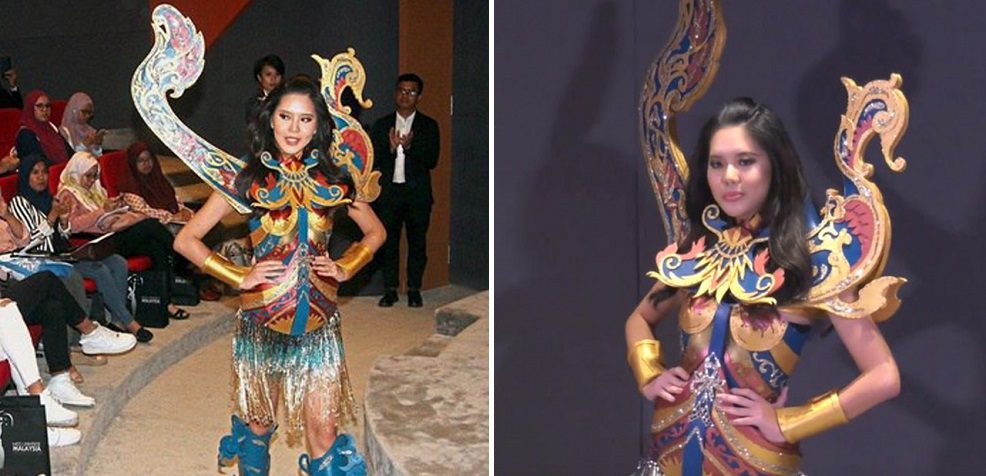
“Bangau Perahu is the chosen national costume for our reigning Miss Universe Malaysia Jane Teoh when she competes in the international pageant in Bangkok, Thailand on Dec 17, 2018,” quips my son, showing me the newsfeed on his phone featuring the Penang lass in her specially designed three-piece outfit.
The brainchild of designer Salleh Hamid, the costume costing RM7,000 is an artistic interpretation of the bangau or sail guard commonly seen on traditional fishing boats in the East Coast of the Malay Peninsula, between Patani and Pahang.
Together with the okok and caping, the bangau makes the front section of Teoh’s flamboyant costume resemble the bow section of a fishing vessel while the playful shimmer of her skirt gives an illusion of the glistening sea water when the boat cuts effortlessly through the surface of the water.

This design makes a bold statement, highlighting the rich Malay cultural history as well as the artistic boat-making craftsmanship still found today in the traditional shipyards of Kelantan and Terengganu.
I particularly like Salleh’s incorporation of the colourful awan larat motifs into his composition as they help bring the intricate Malay wood carving heritage to fore.
TERENGGANU MUSEUM
As I digest the information, I suddenly recall my recent visit to Kuala Terengganu. It was at the State Museum’s vast collection of boats and fishing-related artefacts that I first learnt about the protective attributes of the bangau.
It was believed to have watched over the fisher folk while they set about their task reaping the bountiful harvest from the sea.
The bangau is actually a Malay word, usually applied to the elegant, snow-while cattle egret which is often seen perched on the backs of grazing water buffaloes or on exposed mudflats during low tides.

On fishing vessels, the bangau (4), together with several others like okok (2) and caping (3), represent various decorative projections that served to secure spars, sails, masts and anchors when they’re not in use.
For time immemorial, ingenious boat builders and skilled carpenters have turned these functional vessel parts into decorative art pieces which resemble, sometimes in very abstract form, different types of objects such as the head and neck of a wayang kulit (shadow play) figure, a dragon, a seahorse, a fish, a hornbill or even a duck.
Many historians believe that these ornamental embellishments were possibly relics of the golden age of the ancient Kingdom of Langkasuka.
It has been created and reproduced by countless generations of Malay master boat builders to please the eye of their ruling monarch as well as those of the common folk, many of whom eked out a living as fishermen.
MALAY FISHING BOATS

Some 80 years ago, there were six common types of Malay fishing boats. The largest and most elegant fishing vessel back then was the payang.
Measuring 14 metres long and 2.5 metres wide, it had a tall, steep-rising bow and a stern with equal height. Together with a main sail and a small jib, the payang carried a crew of between 15 to 20 men, a dozen oars and several leaf-shaped paddles.
It was made even more attractive when painted white with horizontal bands of three or more bright colours.
While most payang were built in Terengganu, some were also built in neighbouring Kelantan. The Kelantanese fishermen favoured lighter and shorter versions which were more suited for use on their broader sloping beaches.
The second largest fishing boat was the kolek, measuring about 10 metres in length and had tall curved ends, rising nearly 4 metres from both ends of the keel, forming a shape quite similar to those of a crescent moon.
Apart from the payang and kolek, four other different types of sailing boats were in regular use until the early 1960s.
The kolek kue was a smaller version of the kolek while the 8.5 metre-long bedar had prominent low projections at its ends that resembled a duck’s bill.
The sekochi was the smallest and lightest with plain low ends while the jalora was very similar to the sekochi except that it was built exclusively in Pahang.
Source: NST